Access Menu options

The Trees

Visitors to the National Memorial Arboretum can enjoy a wide variety of trees - many of which have a relevance to the memorials around them.

Although still a 'young' arboretum, there are already in excess of 50,000 trees on the site which are rapidly growing into a unique living tribute.

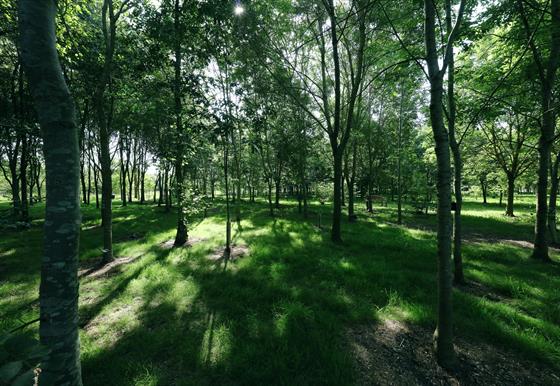
  The Ulster Grove is now an increasingly mature area of woodland
The Ulster Grove is now an increasingly
mature area of woodland

The Beat, an avenue of young chestnuts, was funded by every Police Force in the UK. Chestnuts were chosen because the first truncheons were made from this extremely durable wood. Several of the trees along the avenue were grown from conkers taken from Drayton Manor, the home of Sir Robert Peel, founder of the Police Force.

Visitors to the Chapel will be struck by the twelve pillars of Douglas fir.  Construction of the Chapel was begun in 1999, the 200th anniversary of the birth of Scottish plant collector, David Douglas.  Between 1825 and 1827 David Douglas travelled a staggering 10,000 miles in Western Canada and North West USA on foot and by canoe collecting and classifying plants.  As a result of his efforts, 200 new plants were introduced to the UK, including the Douglas fir.

Six Dawn Redwoods, Metasequoia glyptostrobides, can be found on the Ambulance Service plot.  These magnificent trees, identified as a 'living fossil' in 1941, once blanketed the entire Northern Hemisphere and were thought to be extinct by Western botanists until their rediscovery in 1941 in the Szechuan Province of China.

At the end of the Beat can be found the Golden Grove which celebrates the lives of couples who married at the end of the Second World War and commemorated their 50th anniversary by dedicating trees.  All the trees in the Grove have either golden leaves, stems or fruits such as the golden stemmed ash.

Passing through the Golden Grove you will come across a sinuous line of young redwoods planted by the International Tree Foundation.  During the California Gold Rush in the 1850s, a prospector searching for gold stumbled into a grove of giant redwood trees - Sequoiadendron giganteum.  These are the world's largest trees in terms of volume.  The General Sherman Tree in Sequoia National Park, California, is nearly 84 metres high, with the first branch 40 metres above ground level, and weighs around 2,100 tonnes.  Hopefully the Arboretum's trees will one day be this big!

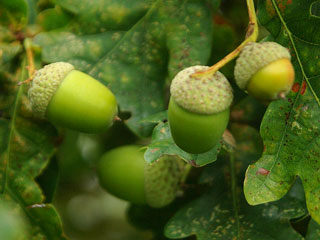
In the wood dedicated to the Merchant Navy convoys, some 2,535 oaks represent the number of British flagged merchant vessels lost to enemy action during World War II.

When the Arboretum was first planted at the end of the last century, the National Arboretum at Westonbirt indicated that it had a small leaved lime, Tilia cordata, that experts believed was several thousand years old, making it the longest living thing in Britain.  Cuttings from this tree were taken and planted in 2000 at the National Memorial Arboretum to form Millennium Avenue, making this avenue, genetically, the oldest in the country.

  Some of the 2355 oaks of the Merchant Navy Convoy
Some of the 2535 oaks of the
Merchant Navy Convoy

Adjacent to Millennium Avenue is a group of easily recognised exotic trees - Eucalyptus, planted to acknowledge the vital role played by Australian airmen, based in UK during World War II.

Of the 33 truly native species found in the UK, such as black poplar and strawberry tree, 32 can be found at the Arboretum.  The only one missing is wych elm, which died as a result of Dutch elm disease.

An azalea garden has been started with Azalea Antelope.  This is dedicated to all who served on HMS Antelope, sunk during the Falklands conflict in 1982 with the loss of two lives.

On many of the plots, the plants and memorials have an interconnecting story.  For example, the Indian Army and Royal Indian Navy plots have trees native to the Himalayas and Southern Asia, such as Himalayan birch, Kashmir rowan and Bhutan pine.

Our basic needs are served by a number of natural resources, including trees.  Few people are aware that natural products and their derivatives represent 50% of all drugs in clinical use.  These include anti-cancer drugs such as Taxol which is manufactured from yew clippings.  There are many yews at the Arboretum and it is hoped that in time these can be clipped and used in the production of Taxol.